
Most people start wondering about their roof somewhere around the 10- or 15-year mark, usually after a neighbor gets a new one or a home inspector mentions it during a refinance. How much life the roof has left depends on the material, the quality of the original installation, and how many Oklahoma hail seasons it has absorbed.
This guide covers the realistic lifespan of each roofing material Red River installs, what Oklahoma weather does to shorten those numbers, and what to watch for as a roof ages. The lifespan ranges in this article are based on what we see in the field after 27 years of inspecting and replacing Oklahoma roofs, not what the manufacturer prints on the packaging.
How Long Different Roof Materials Last in Oklahoma
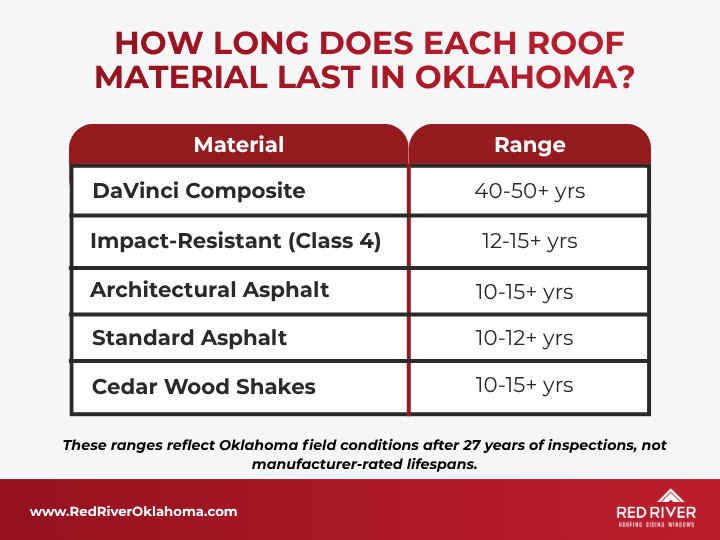
Most roofing articles will tell you a standard asphalt roof lasts 15 to 25 years. Those numbers come from manufacturer testing under controlled conditions. In Oklahoma, the weather has a lot more to say about it than the warranty does. The ranges below reflect what Red River sees on real Oklahoma roofs, not what the spec sheet promises.
Standard Asphalt Shingles (10 to 12 Years)
Standard 3-tab asphalt shingles are the most common roof in Oklahoma. They're affordable, easy to repair, and available from every major manufacturer, including Owens Corning, CertainTeed, and GAF. In a milder climate, these shingles can deliver 15 to 20 years. In Oklahoma, a standard asphalt roof that's installed to manufacturer specifications and makes it to 10 or 12 years has held up well for Oklahoma conditions. If someone gets 15 years, they're doing really well.
These shingles are thinner and lighter than architectural shingles, which means they're more vulnerable to wind lift and granule loss from hail. That's not a manufacturing defect. It's the reality of putting a lighter-weight material on a roof in one of the most active hail corridors in the country.
Architectural and Luxury Asphalt Shingles (12 to 15 Years)
Architectural shingles are thicker, heavier, and more dimensionally stable than 3-tab. They hold up better against wind and have more mass to absorb hail impact before losing granules. Red River installs architectural shingles from GAF, Owens Corning, and CertainTeed, including luxury lines like Belmont that carry lifetime limited warranties from the manufacturer.
In Oklahoma, expect 12 to 15 years of solid performance from a well-installed architectural shingle roof with proper attic ventilation. That's shorter than the 20 to 30 years you'll see quoted on other sites, and the difference is Oklahoma's weather, not the quality of the shingle.
Impact-Resistant Shingles, Class 4 (10 to 15 Years)
Class 4 is the highest impact rating for asphalt shingles. Red River installs several Class 4 options, including TruDefinition Duration Storm from Owens Corning and GAF Armorshield, both designed to flex on impact rather than crack.
The lifespan range for Class 4 shingles in Oklahoma is similar to architectural: roughly 10 to 15 years. The reason to invest in them is what happens during those years.
Think about it this way. Insurance deductibles in Oklahoma are already high and continue to climb. Red River estimates the average homeowner's deductible at around $7,000. A Class 4 roof that makes it through just two of the 1-inch to 1½-inch hailstorms Oklahoma sees regularly that would have otherwise required a full replacement saves that homeowner roughly $14,000 in deductibles they never had to pay. On top of that, avoiding those claims may reduce the risk of premium increases tied to claim history.
That math is a stronger reason to invest in Class 4 shingles than the hope of squeezing out a few extra years. The shingles are not going to last forever. What they will do is give you a much better chance of making it through a hailstorm without needing to file a claim and write a $7,000 check.
Class 4 shingles may also qualify you for a discount on your homeowners insurance premium. The Oklahoma Insurance Department notes that many carriers offer rate reductions for impact-resistant roofing, though the specific discount varies by policy and carrier. Ask your agent before you decide on materials.
DaVinci Composite Roofing (40 to 50+ Years)
DaVinci composite shingles look like natural slate or cedar shake but are made from engineered polymer. They carry Class 4 impact resistance, resist mold and insects, and don't require the maintenance that real wood demands in Oklahoma's humidity.
These roofs carry a higher upfront cost. The tradeoff is that a DaVinci roof installed today could outlast three or four standard asphalt roofs over the same period, which changes the math on what "more expensive" means when you measure it in decades instead of one installation.
Traditional Cedar Wood Shakes (10 to 15 Years in Oklahoma)
Cedar shakes look great, but Oklahoma is hard on them. Humid summers, freeze-thaw cycles, and hail exposure shorten their lifespan significantly compared to drier climates. Red River's own experience puts a realistic range at 10 to 15 years in this part of the country before the wood starts showing serious wear: color fade, mold, rot, and splitting.
Wood shakes also come with fire safety considerations. Most are unrated by Oklahoma fire safety codes, which matters if your neighborhood or insurer has specific requirements. If you love the cedar look, DaVinci composite gives you the same appearance with Class 4 impact resistance and none of the moisture problems.
Why Oklahoma Roofs Don't Last as Long as the Warranty Says
Just because a manufacturer puts a 30-year or lifetime warranty on a shingle doesn't mean that roof is going to last 30 years in Oklahoma. Our weather has a lot more to say about that than the warranty does. The gap between the rated lifespan and the real one comes down to four things.
Hail damage compounds over time
Oklahoma sits in the middle of hail alley. A single severe hailstorm can strip years of granule protection off an asphalt roof in 20 minutes. The damage is often invisible from the ground. Granule loss doesn't mean your roof leaks tomorrow, but it means the UV and moisture barrier those granules provided is gone. Aging accelerates from that point forward, and the next storm hits a roof that's already weaker than it looks.
Wind loosens what hail doesn't break
Straight-line winds and storm gusts lift shingle edges, break sealant bonds, and loosen flashing around vents, chimneys, and skylights. A single lifted shingle isn't always visible from the yard, but it creates an entry point for water that can damage the decking underneath for months before anyone notices.
Summer heat works from both sides
Oklahoma summers regularly push 100 degrees. That heat bakes shingles from above. If the attic underneath isn't properly ventilated, the shingles are getting baked from below at the same time. That two-sided heat stress accelerates curling, cracking, and brittleness faster than most homeowners expect.
Temperature swings fatigue the materials
Oklahoma can shift 40 or 50 degrees in a single day. Every swing causes roofing materials to expand and contract. Over years, that repeated movement loosens fasteners, stresses sealant, and fatigues the shingle material itself. This is a slow, cumulative kind of wear. It shows up as a roof that seems fine until it isn't.
What Wears a Roof Out and How to Tell It's Happening
Weather gets most of the blame, and it deserves a lot of it. But some of the biggest factors are inside the house or buried in how the roof was installed. Each one below includes what to watch for so you can spot the problem before it becomes expensive.
Poor Attic Ventilation
A hot, poorly ventilated attic traps heat against the underside of the roof deck. That trapped heat bakes shingles from below while the sun bakes them from above. Over time, this causes curling, brittleness, and premature granule loss. Red River checks attic ventilation on every residential roofing inspection because it's one of the most common and most fixable reasons a roof ages faster than it should.
The warning sign: shingles that curl or crack uniformly across the roof, not just in storm-damaged spots. If the wear pattern is even rather than localized, ventilation is usually part of the cause.
Installation Shortcuts
The shingle is what you see. Underneath it, the underlayment, the flashing around every penetration, the nailing pattern, and the starter strips along the eaves are what keep water out. Shortcuts on any of these can cut years off a roof's life without any visible sign until a leak shows up. This is one reason manufacturer certifications like GAF Master Elite matter. The program requires specific training and installation standards to qualify for the strongest warranty tiers. Fewer than 2% of roofing contractors nationwide hold that designation.
How you'll spot it: leaks showing up around vents, chimneys, or skylights rather than in the open field of the roof. Flashing failures and poor nailing are almost always the source of early leaks on roofs whose shingles still look fine from the ground.
Clogged Gutters and Standing Debris
Leaves, branches, and debris hold moisture against the shingles and the roof edge. That moisture accelerates shingle deterioration and can cause water to back up under the drip edge, damaging fascia and decking. Clean gutters are not a cosmetic issue. They directly affect how long your roof lasts.
Check for dark staining along the roof edge, soft or peeling fascia boards, or water marks on the underside of the eaves.
Storm Damage That Goes Unaddressed
Not every storm warrants a full replacement. But storm damage that goes uninspected compounds over time. Granule loss from one hailstorm makes the shingle more vulnerable to the next one. A missing shingle exposes underlayment that was never designed to be a primary weather barrier for more than a few weeks. If your roof took a hit and you're not sure whether it's worth a claim, Red River's insurance claims team can walk you through the process and help you decide.
Signs to watch for: losing shingles repeatedly in moderate wind, gritty granule buildup in your gutters after rain, or ceiling stains that show up after storms and keep coming back in different spots.
Skipped Maintenance
A loose piece of flashing is a $200 repair. Left alone for two years, it becomes a $2,000 leak and decking replacement. Small problems on a roof don't stay small, especially in Oklahoma where every storm season tests whatever weak point already exists.
By the time you can see it from the ground, it's been building for a while: a sag in the roofline, a soft or spongy feeling underfoot (leave that check to a professional), or daylight visible through the roof when you go into the attic on a sunny day.
A 10-Year-Old Roof Doesn't Automatically Need Replacing
Nothing in this article should give a homeowner the impression that a roof hitting 10 or 12 years old needs to come off. Age is one factor. Condition is what matters.
That's where Red River's 360° Exterior Inspection comes in. We walk the roof, check the attic ventilation, document everything with photos, and put together a Home Treatment Plan that separates what needs attention now from what we should keep an eye on and what can wait. Some roofs at 12 years are in great shape and have years of life ahead of them. Others at 8 years have been hit hard and need work. The inspection tells the real story, and the Home Treatment Plan puts it in writing so the homeowner can make their own decision on their own timeline.
Red River's goal is never to sell someone a roof they don't need. It's to give them an honest picture of where things stand so they can plan ahead rather than react to a problem they didn't see coming.
If your roof is past 10 years or you've been through a few storm seasons without an inspection, a 360° Exterior Inspection is the simplest way to find out where things stand.
How to Get More Years Out of Your Roof
The difference between a roof that lasts 10 years in Oklahoma and one that lasts 15 usually comes down to a few habits that cost very little compared to the repair you avoid.
Get your roof inspected once a year, and again after any major storm. An annual inspection catches small problems before they compound. A post-storm inspection catches damage you can't see from the ground. Both cost far less than the repair you'd need if you skip them.
Keep gutters and downspouts clear. Water that backs up at the roof edge damages fascia, soffit, and the edge of the decking. Clean them twice a year. If you have trees overhanging the roof, clean them more often.
Cut overhanging branches back at least 6 feet from the roof surface. Branches scrape shingles in the wind and drop debris that holds moisture against the roof.
Fix small things before they sit through a storm season. Loose flashing, a cracked pipe boot, a lifted shingle. Each one is a small, cheap repair right now. Each one becomes water damage if it stays open through the next round of hail or heavy rain.
Check whether your attic ventilation is doing its job, not just whether the vents exist. Blocked soffits, insulation covering intake vents, or an inadequate ratio of intake to exhaust can make even a well-designed system perform poorly.
When It Makes More Sense to Replace Than Repair
Not every problem means a new roof. But there's a point where patching stops making financial sense.
Your roof is past two-thirds of its expected lifespan and showing multiple signs of wear across the roof, not just in one spot. An 8- or 9-year-old standard asphalt roof with curling, granule loss, and a couple of past repairs is telling you something.
Repairs are stacking up. If you've had two or three repairs in the last few years, the next storm is probably going to add another one. At some point, the cumulative cost of patches approaches the cost of doing it once, correctly, with materials that reset the clock.
Your insurance carrier is moving you from a replacement-cost policy to actual-cash value because of the roof's age. That shift means your next claim payout drops significantly. Replacing before that happens can be a better financial decision than waiting for a storm to force it. The Oklahoma Insurance Department has more information on how these policy types differ.
If you're weighing the numbers, we wrote a detailed breakdown of roof replacement costs in Oklahoma for 2026 that covers material pricing, what drives the total up or down, and how to compare bids.
Red River also offers financing at 0% interest for 18 months for homeowners paying out of pocket. It's there so the decision to replace isn't forced by a lump-sum payment when the roof's age puts it outside insurance coverage.
Frequently Asked Questions
How long do asphalt shingles last in Oklahoma?
Standard 3-tab asphalt shingles typically last 10 to 12 years in Oklahoma. Architectural shingles last 12 to 15 years. Impact-resistant Class 4 shingles can also last 10 to 15 years, but their real value is surviving hailstorms that would otherwise require a full replacement. These numbers are based on what Red River sees in the field, not manufacturer ratings, which assume milder conditions than Oklahoma delivers.
Why should I invest in Class 4 impact-resistant shingles?
The biggest reason is deductible savings. Oklahoma deductibles average around $7,000, and a Class 4 roof that survives just two hailstorms that would have otherwise triggered a claim saves roughly $14,000 in deductibles the homeowner never had to pay. Avoiding those claims can also reduce the risk of premium increases. Class 4 shingles may also qualify for an insurance discount on their own. Ask your agent.
Can I make my roof last longer without replacing it?
Yes. Annual inspections, prompt small repairs, clean gutters, and proper attic ventilation make the biggest difference. A well-maintained roof can outlast a neglected one by several years on the same materials.
How do I know if my roof needs to be replaced or just repaired?
A single problem, like a missing shingle or a damaged pipe boot, is usually a repair. Multiple problems showing up across the roof at the same time, especially on a roof past its expected lifespan, usually points toward replacement. The clearest way to know is to get a 360° Exterior Inspection that documents the full picture and gives you a Home Treatment Plan separating what needs attention now from what can wait.
Does a new roof increase home value?
Yes. A new roof is consistently one of the highest-return exterior improvements in resale value. It removes a major negotiation point for buyers and their inspectors, and in Oklahoma's market, a visibly aging roof is one of the first things that can stall or reduce an offer.
How often should I have my roof inspected in Oklahoma?
At least once a year, and after every significant storm. Oklahoma's storm frequency makes post-storm inspections more important here than in most states. Red River offers a 360° Exterior Inspection that covers the roof, the attic, ventilation, and the full exterior.
You Don't Need a Storm to Know Where Your Roof Stands
If your roof is past 10 years or it's been through a few storms and never been checked, a 360° Exterior Inspection is the simplest way to stop guessing.
Red River has been inspecting and replacing Oklahoma roofs since 1999. Over 17,000 projects. We’ll document what we find, build a Home Treatment Plan that tells you what needs attention now and what can wait, and give you a straight answer about where things stand. If your current roof is standard asphalt approaching the end of its life, the conversation about what goes on next, whether that’s architectural, Class 4, or composite, is one of the most important parts of that plan.
And if you’re weighing the numbers, here’s our full breakdown of roof replacement costs in Oklahoma for 2026.